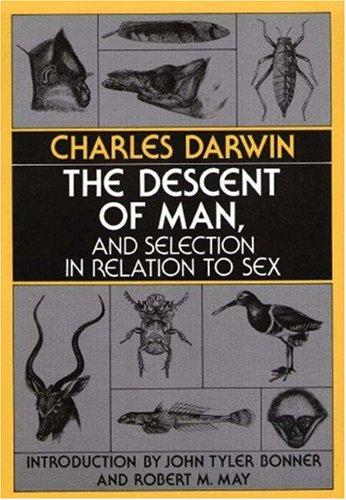
The Descent of Man and Selection in Relation to Sex
Read Free or Buy
As an affiliate, we earn from qualifying purchases. Disclosure
About This Book
The Descent of Man, and Selection in Relation to Sex is Charles Darwin's second most important work after On the Origin of Species. Published in 1871, it addresses two questions Darwin had avoided earlier: the evolution of humans from animal ancestors and sexual selection. Part One marshals evidence that humans share a common ancestor with primates, presenting the first use of the word 'evolution' in Darwin's published works. Part Two constitutes an extended treatise on sexual selection — how traits improving mating success are inherited — analyzing plumage in birds, antlers in deer, and secondary sexual characteristics across the animal kingdom. The intellectual breadth is astonishing, drawing on zoology, anthropology, psychology, and ethics, with core scientific insights that remain foundational to evolutionary biology.
Excerpt
The nature of the following work will be best understood by a brief account of how it came to be written. During many years I collected notes on the origin or descent of man, without any intention of publishing on the subject, but rather with the determination not to publish, as I thought that I should thus only add to the prejudices against my views.— Opening of The Descent of Man and Selection in Relation to Sex
About the Author
Publication Details
| First Published | 1871 |
|---|---|
| Publisher | John Murray |
| Pages | 898 |
| ISBN | 9780691023694 |
| Language | En |
| Copyright | Public Domain |
| Open Library | View editions |